
The 48 hours that decide your conference ROI
A rep at a 3-day conference has 50 plus conversations. By Monday morning, most are gone. By the following Monday, even the ones that mattered have decayed into a generic "we met at the event" memory. The math on whether a 50K booth produced pipeline runs on what happens in the hours and days right after the floor closes.
80 percent of trade show leads are never followed up on at all. Of the ones that are, response rates fall from 25 percent within 24 hours to under 8 percent after 72 hours. The follow-up window decides the show, not the booth design.
Think about a conference in four time windows. At each one, the probability of converting a conversation drops. Knowing what is happening at each, and what the best reps do differently, is the difference between a show that books pipeline in Q3 and a show that reads as a loss.
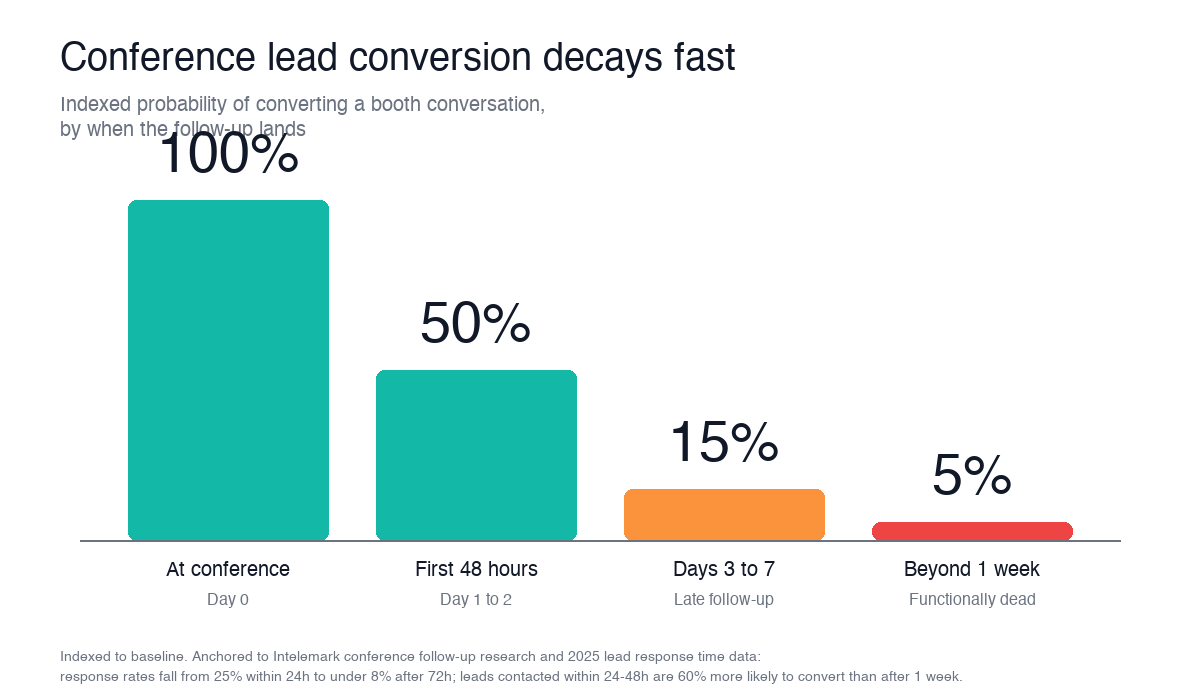
Window 1: At the conference (Day 0)
The rep is on the floor for 8 hours a day across 2 to 3 days. Time is spent in a 10x10 booth, scanning badges, demoing the product, pitching the same line 50 times, eating ham sandwiches, walking the aisles between sessions. Pace is high. Cognitive load is higher.
The myth most reps carry: "I will remember the good ones." The reality: a rep who has 50 conversations in a day retains specific context on roughly 6 of them within 72 hours. Cognitive research backs this; customer interviews confirm it.
What most reps do at this stage: scan badges, hand out swag, surface-level chat, jot a name on the back of a card. The data captured is a name and an email. The conversation is in the rep's head, where it will not stay.
What top reps do: capture context in real time, during or immediately after the conversation. A 30-second voice note. A transcript. Three lines per name: who they are, what they need, what they specifically said. Not the name. The context.
The floor is the highest-leverage moment for capture because working memory is at its peak right now and will not be again. Anything captured here compounds. Anything left for later degrades.
Window 2: The first 48 hours after the conference
The rep is on a plane home, then asleep, then catching up on 400 unread emails. Family. Laundry. The Monday call she did not prep for. Most reps spend this window doing anything except follow-up.
Industry data: 80 percent of trade show leads are never followed up on. 40 percent of exhibitors wait 3 to 5 days before reaching out at all. The reps who do follow up in this window mostly send a generic "great meeting you at the event" template at 4 PM Friday. The buyer reads it on Monday, cannot place the rep, archives it.
What top reps do in this window: specific, contextual follow-up. Reference the actual conversation. The objection the buyer raised. The demo step they were curious about. The specific reason they said they were at the event. A 4-sentence message that is unmistakably about this buyer, sent before the buyer is back at the desk.
Memory plus speed compounds. Leads contacted within 24 to 48 hours are 60 percent more likely to convert than those reached after a week (Intelemark). The buyer remembers you and the specific exchange. A sharp message gets a sharp response. A template gets archived. By the time the buyer is back to a normal week, you have either landed in the "real conversation" bucket or the "noise" bucket. There is no second chance to land in the first.
Window 3: Days 3 to 7
The rep is back at the desk. Pipeline reviews, scheduled calls, the regular grind. New MQLs hitting the queue. The conference is now "that thing last week."
Time is spent on deal management, prospecting, internal meetings. The conference lead has dropped down the priority stack. Other vendors who followed up faster have already started their email sequences. Competitive memory is fading from the buyer's side.
Response rates collapse fast. They drop from 25 percent within 24 hours to under 8 percent after 72 hours. By day 5, the response rate has dropped by more than two thirds.
What most reps do: bulk-send a Monday template to everyone they scanned. Some get personalized; most do not. Reply rates collapse.
What top reps do: salvage with surgical messages. Reference the exact moment of the conversation. Pattern-match yourself back into the buyer's memory. "You mentioned your team is rolling out the new comp plan in Q3" lands. "Great to connect at the event" does not. By day 5, you are racing the buyer's calendar and other reps who got their follow-up out faster.
Window 4: Beyond 1 week
The conversation is functionally dead. When trade show leads are followed up within 7 to 10 days, 20 to 30 percent of them typically convert to opportunities. After that window the curve falls to single digits.
Time is spent chasing new pipeline, prepping the next event, blaming the conference for not producing.
What most reps do: nothing, or send a generic "circling back" sequence that gets ignored.
What top reps do: triage. Pick the 5 buyers who were genuinely high-intent and switch channels. LinkedIn DM. A direct call to the office. An intro through a mutual contact. Do not send another email; they have already deleted three from you.
At this stage, only high-effort, channel-shifted moves cut through. The default path failed; brute force is what is left.
The takeaway
Reps know all of this in theory. The system to execute on it does not exist on most teams. Memory is treated as a willpower problem because no one has built tooling that handles it. Speed is treated as a calendar problem because nobody has structured the post-event hours.
The four-window framework is not complicated. It is operational:
- Floor: capture context in real time. Not the name. The context.
- First 48 hours: contextual follow-up out the door. Specific, not template.
- Days 3 to 7: surgical salvage messages for the conversations worth chasing.
- Beyond 1 week: switch channels or move on.
Tools exist that close the gap on this. Bantor was built for it: real-time conversation capture during the booth conversation, contextual follow-up drafts ready before the rep checks out of the hotel, and a clean triage view for the high-intent buyers worth a Monday call.
For the VP Sales planning the next conference: do not audit the booth design. Audit what happens between the floor and Monday morning. The math is in the window.
Ready to capture every conference conversation and follow up before the floor closes? Book a demo.
Capture every conversation. Follow up with context.
Bantor helps sales reps and networkers turn conference conversations into closed deals.
Get started Today